
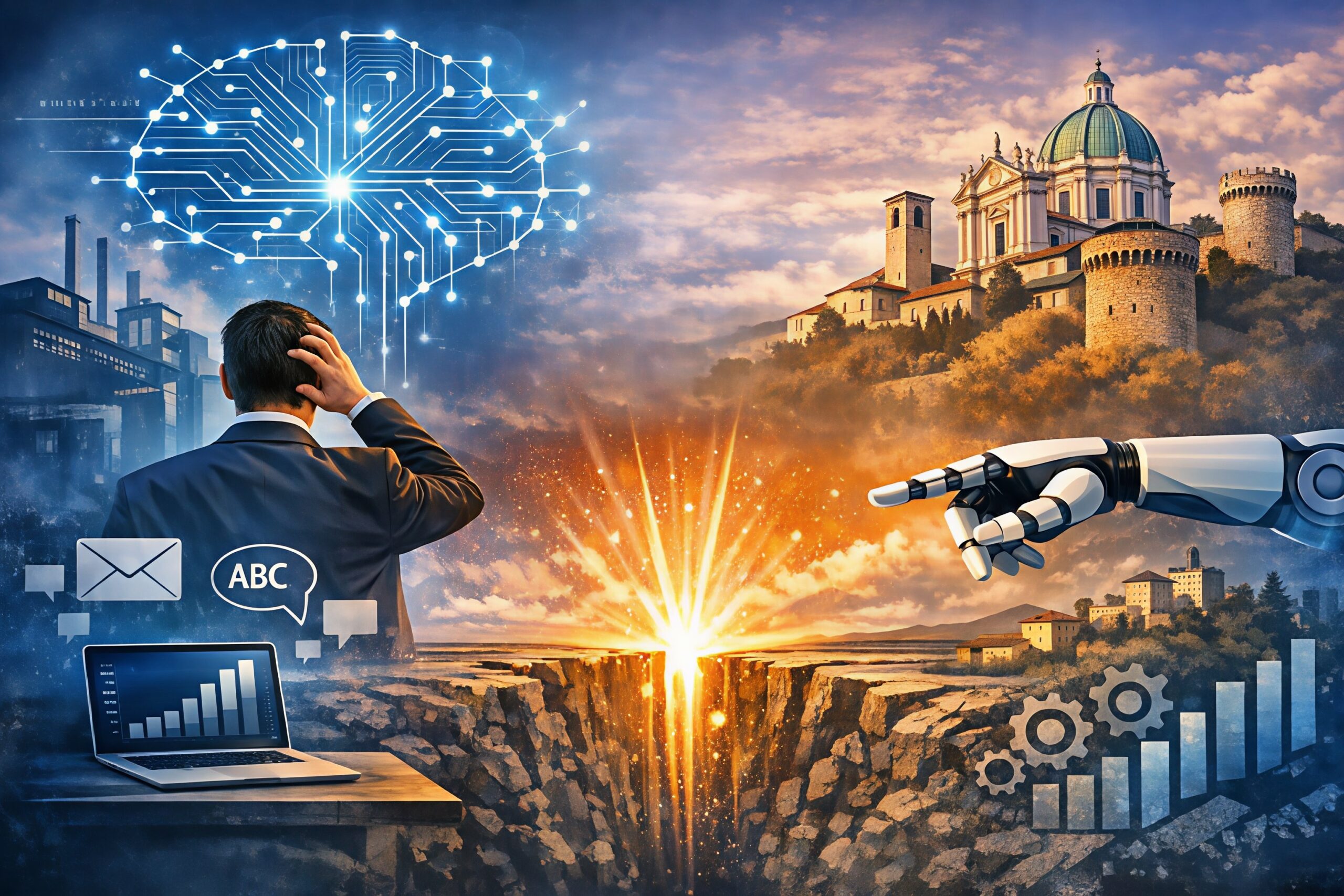
We are pleased to share the interview that our CEO, Antonio Perini, gave to the daily newspaper BresciaOggi on 5 May 2026, as part of its Primo Piano – Tecnologia e strategie (In Focus – Technology and Strategies) column.
It is a valuable opportunity to reflect on one of the most pressing issues for Italy’s business community: the relationship between small and medium-sized enterprises and Artificial Intelligence. Speaking as President of Unimatica Confapi Brescia, Antonio Perini paints a clear, direct picture of the current situation, based on two years of meetings and hands-on training with local entrepreneurs.
The full text is reproduced below. Happy reading.
Interview by Michela Bono – “BresciaOggi”, 5 May 2026
Artificial Intelligence, the great unknown. The analysis of SMEs in the Brescia area by Antonio Perini, president of Unimatica Confapi Brescia – the association of small and medium-sized IT and telematics companies – shows how unaccustomed local entrepreneurs still are to considering AI an integral tool in their processes. Perini reached this conclusion after two years of meetings and courses on the subject.
“My sense is that the figure for superficial knowledge of AI is around 60%, and that entrepreneurs, more or less, know they have to reckon with it. On the other hand, the companies that are actually doing something to use it in a structured way seem to me to be well below 5%. Take Industry 4.0 and 5.0: yes, they bought high-performance machines, but they use them just as before.”
Basically, the expert explains, it is used for simple tasks such as writing emails, producing translations and presentations, or getting general food for thought, but not to change the fundamental character of how the business is organised, as should be the case to remain competitive with other countries.
“Today it is still confused with automation, but AI is much more than that,” explains Perini. “Microsoft data tells us there is an incredible gap between large and small companies, not only in AI but in digitalisation in general, whose actual use in processes stands at 67% in the former, while it is stuck at 9% in the latter. In AI, the gap is certainly wider.”
What is at stake, says Perini, is the competitiveness of SMEs, because the gap in employee productivity is already real: “For European companies, average productivity is around 120,000 euros per person, in Italy it is 99,000, and AI could help close this gap.” The Confapi manager believes that the prevailing mistrust is a mental barrier.
“Business owners must understand that this is an issue they cannot delegate to their staff: they must be the first to get trained, because the real impact of AI is organisational, not just technological.”
In short, delegating to the IT manager is not enough; more needs to be done. Between now and 2040, Perini points out, Italy will be short of 3.9 million workers: “AI will necessarily have to be used to fill this shortfall, especially in low-profitability jobs that are not worth wasting time on, so that people can focus on more important and strategic tasks. And this is the organisational impact I am talking about.”
The difficulty in finding AI skills is part of the problem. At university, as in technical colleges, it is still discussed in abstract terms, and young people, Perini reports, are largely absorbed by the Milan area once they graduate, where large companies offer more attractive career prospects and security than roles in which digitalisation is still applied merely to running machines.
“To bring AI into the organisation, and not just into automation processes, more knowledge is needed. You also need the right skills to understand whether what it gives you back is correct: when I work on my own projects, it takes hours to load the data into the system correctly, to review the answers and to refine the angles of the output. AI is a secretary, not my boss. I am the one who guides it.”
70% of employees already use it, even though it is not an official work tool – but, as mentioned, mostly for routine tasks: texts, translations, emails and presentations.
“The big risk here is cybersecurity, because the information they enter into these systems ends up on the web. That is why people need to be trained in responsible use.”
For this reason, Unimatica Confapi has also signed a memorandum of understanding with Microsoft and another with the Polizia Postale (the Italian Postal and Communications Police).
Perini concludes:
“Companies cannot rely on a mere hardware supplier; they must budget resources for cybersecurity.”
Related news
All news